
How to Write Website Copy That Converts: Small Business Guide

Your website design gets noticed. Your copy is what closes or loses the customer. This guide is for small business owners who want website copy that converts visitors into leads without hiring a professional copywriter. You'll get the exact formula for four high-impact sections: your homepage headline, your about page, your service descriptions, and your CTAs.
The Design Looks Great. Why Isn't Anyone Contacting You?
Most small business owners invest in a website that looks professional, loads fast, and works on mobile. Then they wait for the leads to come in.
They often don't.
The culprit is almost never the design. It's the copy the words on the page. Specifically, website copy written from the business's perspective instead of the customer's. Generic, placeholder-level writing that tells a visitor nothing useful about why they should choose you over anyone else.
Research from the Nielsen Norman Group confirms that visitors form a first impression in under 50 milliseconds and copy clarity is one of the primary factors that determines whether they stay. The good news: you don't need to be a copywriter to fix it. You need four specific fixes applied to four specific sections.
Fix 1: Your Homepage Headline Is Not Your Business Name
Open a new tab and look at your homepage right now. What's the first line of text a visitor reads?
If the answer is your business name, a tagline about quality and trust, or anything resembling "Welcome to our website" you've already lost a significant portion of your visitors. They arrived with a question. Your headline gave them no answer.
A converting homepage headline answers three questions in a single sentence:
● What do you do?
● Who is it for?
● Why does it matter or what makes it different?
❌ Wrong "Welcome to Smith & Sons" |
✅ Right "Fast, Affordable HVAC Repair for Dallas Homeowners Same-Day Booking Available" |
The right version tells a visitor exactly what they need to know in under five seconds. The wrong version tells them nothing except that a business exists.
Write three headline drafts using the What + Who + Why framework. Read each one aloud. The one that sounds most like something a happy customer would say about you is usually the right one.
Fix 2: Your About Page Is Not About You
The About page is the second-most visited page on most small business websites. Visitors land there after reading your homepage they're already mildly interested, and they're trying to decide if they trust you enough to get in touch.
Most About pages answer this moment with a founding story, a mission statement, and a list of values. None of that is what the visitor came for.
They came to answer one question: does this business deliver results for people like me?
Restructure your About page in this order:
● Open with what you've achieved for clients a specific result, number, or before/after outcome
● Follow with what makes your approach different from the obvious alternatives
● End with credentials, experience, and your founding story as supporting evidence

Credentials earn trust after results have created interest. Putting credentials first before you've established relevance is the equivalent of opening a sales conversation with your resume.
Research from CXL Institute consistently shows that outcome-led About pages outperform credential-led ones on trust metrics. If you don't have client results to reference yet, use the specific methodology or process that makes your work different. Specificity is what builds trust, not seniority.
Fix 3: Your Service Descriptions Describe Features Not Benefits
Features describe what you offer. Benefits describe what the customer experiences as a result. This gap is where most website copy that converts small business visitors into clients actually lives and where most service descriptions fall short.
Run through your service descriptions and ask yourself: would a customer care about this sentence, or does it only matter internally?
Feature (what you do) "We use premium roofing materials and follow manufacturer installation guidelines." |
Benefit (what the customer gets) "Your roof will outlast the industry average by 15 years and every installation comes with a written performance guarantee." |
The second version earns attention because it answers the customer's underlying question: what does this mean for me?
Go through every bullet point and paragraph on your service pages. For each feature statement, ask "so what?" until you reach the actual customer outcome. That outcome is what you should be writing.
Pay attention to sentences that begin with "We". Most feature-first copy starts with "We" because it's written from your perspective. Benefit-first copy tends to start with "You" or "Your" a simple editing pass that improves almost every service page.
Our web design service and web development service pages are both written using this benefits-first framework you can use them as a reference for structure and tone.
Fix 4: Your CTAs Tell Visitors What to Do, Not What They Get
A call-to-action is the most tested element in digital marketing. It's also the element most small business websites get completely wrong.
The problem isn't placement. It's the words. "Submit" and "Contact Us" describe actions the visitor must perform. They don't describe anything the visitor will receive. That framing however subtle creates friction.
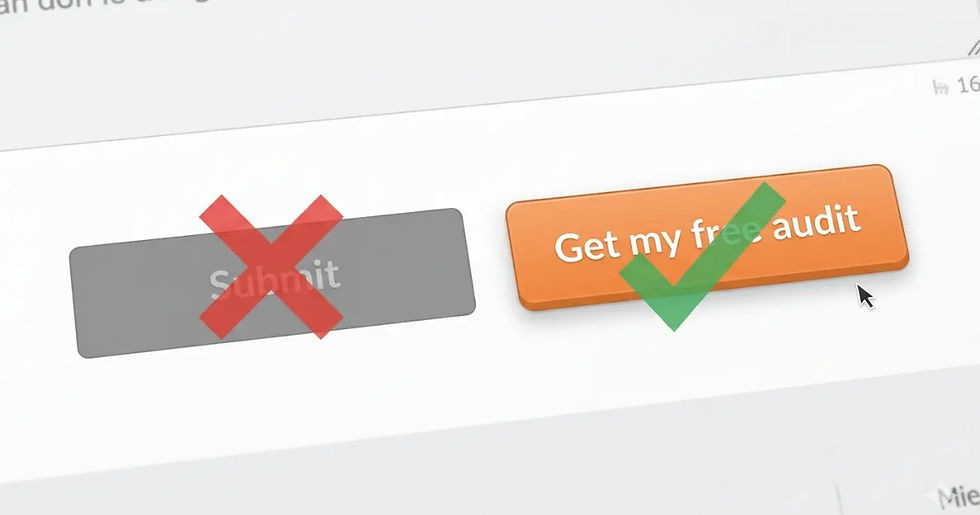
❌ Action-framed CTAs (avoid) "Submit" / "Contact Us" / "Get In Touch" / "Learn More" |
✅ Outcome-framed CTAs (use these) "Get my free audit" / "See how it works" / "Book a 15-minute call" / "Start my free quote" |
Three rules for CTA copy that consistently converts better:
● Use first-person language "Get my free quote" outperforms "Get your free quote" in almost every split test. The shift from "your" to "my" changes the psychological frame from compliance to self-interest.
● Name the specific outcome "Book a 15-minute call" converts better than "Schedule a consultation" because the specific time commitment removes the imagined friction of an open-ended sales conversation.
● Eliminate every word that doesn't carry meaning "Click here to contact us today to get started" has four redundant words. "Get my free quote" has none.
For a deeper dive into CTA copywriting and A/B testing frameworks, read our full guide on the CTA copywriting formula that consistently outperforms generic buttons.
How to Audit Your Own Website Copy in 20 Minutes
You don't need to rewrite your entire website at once. A targeted 20-minute audit will surface the highest-priority fixes.
● Open your homepage. Read only the headline and subheadline. Could a first-time visitor tell exactly what you do, who you serve, and why it matters? If not, the headline is the first fix.
● Open your About page. Read the first paragraph. Does it mention a client result or outcome? Or does it start with your founding story, mission, or credentials? If the latter, reorder.
● Open your top service page. Highlight every sentence that starts with "We". Rewrite each one to start with "You" or "Your" then add the customer outcome the feature creates.
● Find every CTA button on the page. If any say "Submit", "Contact Us", or "Learn More" in isolation, rewrite them using the outcome framework above.
These four changes are the foundation of website copy that converts small business visitors into actual leads and none of them require a developer or a budget.
If you want a professional review of your copy before making changes, book a free 15-minute website audit at AIPro.PH. We look at your copy, conversion structure, and technical setup and tell you exactly what to fix first.
Ready to Fix Your Website Copy?
AIPro.PH builds and rewrites small business websites with conversion-focused copy built in from day one not bolted on after the fact.
Every website we deliver includes professionally written homepage headlines, service page copy, about page structure, and CTAs all tested against the four-fix framework in this guide.
Frequently Asked Questions
Does my website copy actually affect how many leads I get?
Yes and usually more than the design does. A visitor who lands on a page with a clear headline, a relevant value proposition, and a specific CTA converts at a measurably higher rate than one who lands on a well-designed page with generic copy. Copy determines whether a visitor understands what you do and trusts you enough to act. Design determines whether they stay long enough to read it.
How long should a homepage headline be?
Between 8 and 15 words is the practical range for most small businesses. Long enough to answer all three questions what you do, who it's for, and why it matters without becoming a run-on sentence. The best headlines are specific, not clever. A headline that makes a visitor think "that's exactly what I need" beats one that makes them think "that's a nice turn of phrase."
What is the difference between features and benefits in website copywriting?
A feature describes what your service includes or how it works. A benefit describes what the customer experiences as a result. "We use premium materials" is a feature. "Your installation comes with a 10-year performance guarantee" is the benefit that feature creates. Customers buy outcomes not processes. Write every service description from the outcome end.
How do I know if my current copy is the problem?
Run the 20-minute audit in this guide. If your homepage headline doesn't answer what you do, for who, and why that's the problem. If your about page opens with your founding story before mentioning client results that's the problem. If your CTAs say "Submit" or "Contact Us" that's the problem. Any one of these alone will suppress your conversion rate. All four together make even a well-designed website invisible in its effectiveness.
Key Takeaways
● Rewrite your homepage headline to answer three questions in one sentence: what you do, who it's for, and what makes it matter. Do this before any other copy change on your site.
● Restructure your About page to lead with client outcomes and results move credentials and founding story to the end where they serve as supporting evidence, not the opening argument.
● Audit every sentence on your service pages that starts with "We" rewrite each one to start with "Your" and end with the customer outcome the feature creates.
● Replace every CTA that says "Submit", "Contact Us", or "Learn More" with outcome-specific, first-person language: "Get my free quote", "Book my 15-minute call", "See how it works".



Comments