7 Trust Signals Every Small Business Website Needs to Convert Visitors Into Customers

When a potential customer lands on your website, they're asking one question: Should I do business with this company?
They don't care about your feature list yet. They care about whether they can trust you. This difference is everything. Websites that build trust convert 2-3 times better than generic alternatives, yet most small business websites miss the signals that tip the scale.
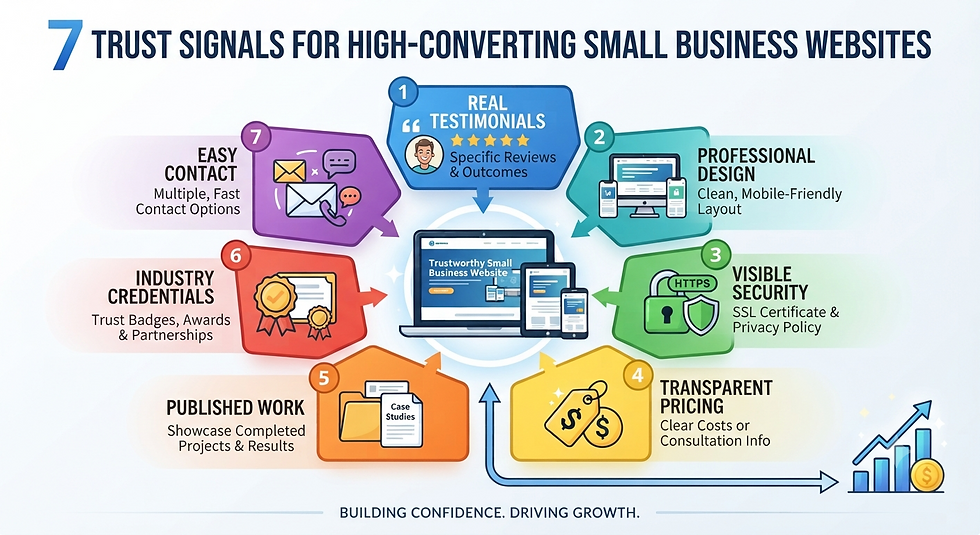
We've analyzed what separates high-converting websites from the rest, and it comes down to seven specific trust signals that every small business needs.
1. Real Customer Testimonials and Reviews: The First Trust Signal for Small Business Websites
Testimonials aren't nice-to-have extras. They're the most persuasive asset on your site because they come from people your prospects can relate to.
The catch? Generic testimonials ("Great company!") don't move the needle. Real trust comes from specific reviews that mention concrete outcomes. A client commenting "They helped me cut my admin work in half and freed up 20 hours per week" carries far more weight than "Excellent service."
The highest-converting websites display testimonials from recognizable, verified customers. If you can include a client name, their business type, and a specific result, do it. Prospects are likelier to believe a review from "Sarah Martinez, Owner of Clean Concepts Cleaning" than an anonymous "John D."
Place testimonials near your main CTA and on service pages where they counter specific objections. If your conversion rate is stagnant, this is often the first place to look.
2. Professional Design That Works
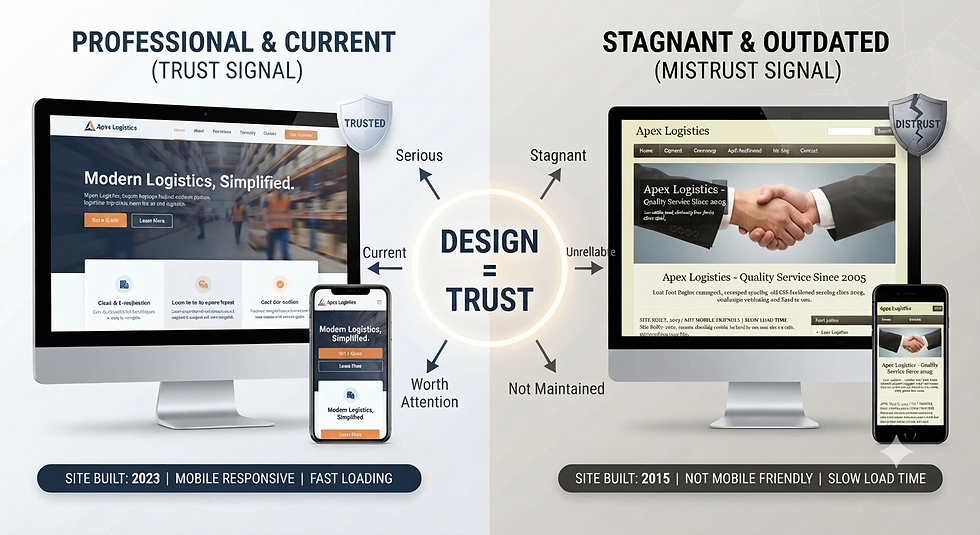
Your website design is a trust signal before anyone reads a word. This isn't about following trends or winning design awards. It's about whether your site looks like it was built recently and actually works on mobile devices.
A website built in 2015 that looks like it hasn't been updated signals that your business is stagnant. Visitors unconsciously assume: if you don't maintain your own website, how do I trust you to maintain a professional setup for my business?
Professional doesn't mean complicated. It means clean layouts, readable typography, proper spacing, and images that don't look like they came from a free stock photo library circa 2010. Your site should load fast, display correctly on phones, and be easy to navigate.
When you invest in quality web design, you're doing more than refreshing your appearance. You're telling visitors your business is serious, current, and worth their attention.
3. Visible Security and Privacy Protection
Visitors notice security signals, even if they don't consciously realize it. That little padlock icon in the browser, an SSL certificate, and a clear privacy policy all matter.
If your website isn't HTTPS (the "S" stands for secure), every visitor sees a warning. That red flag doesn't just hurt trust; it actively damages it. Implement an SSL certificate immediately if you haven't already.
Beyond the technical basics, include a privacy policy that actually addresses how you handle customer information. This isn't legal theater. It shows you've thought about protecting visitor data and aren't collecting information for hidden purposes.
4. Transparent Pricing and Clear Service Descriptions
Vague pricing kills conversions. When visitors can't find your price, they assume you're hiding something expensive.
The most trustworthy small business websites show prices prominently. If your services are custom-quoted, say so explicitly: "Pricing varies based on your specific needs. Let's discuss your project in a free consultation." That transparency builds more trust than a blank page.
Service descriptions should use plain language, not jargon. Explain what you actually do, who it's for, and what problems it solves. If you offer AI chatbots or automation services, describe the specific benefits: "24/7 customer responses," "automatic lead qualification," or "reduced response time from hours to seconds."
5. Published Work and Case Studies
Case studies are proof. They show that you didn't just do the work once; you have a track record of solving real problems for real businesses.
A case study doesn't need to be elaborate. It needs to be specific: What was the situation? What was the challenge? What did you do? What were the results?
The highest-converting businesses publish their work openly. This might be a gallery of website design projects, before-and-after screenshots, client results, or detailed case studies. Each piece of published work serves as proof that you deliver.
If confidentiality agreements prevent you from sharing client names, you can still show the work and describe the transformation anonymously. The combination of specific results and real screenshots is far more persuasive than a vague portfolio.
6. Industry Recognition and Credentials
Third-party validation is worth more than self-promotion. Certifications, partnerships, awards, and media mentions signal that external experts vouch for you.
If you're a a Wix Partner certification , display that badge. If you've been featured in an industry publication, mention it. If you hold a relevant credential, include it visibly.
The key is authenticity. A genuine partnership with a platform or recognition from an industry body carries real weight. Generic "awards" you created yourself do not.
7. Easy Ways to Get Help
Friction kills trust. If a visitor wants to ask a question or request a quote and there's no obvious way to do it, they'll leave.
The best trust signal in this category? Quick response times. If you say "We'll respond within 24 hours," you're setting an expectation you can meet. If someone reaches out and hears nothing for a week, you've broken trust.
Make contact easy. Include a phone number, email, contact form, and live chat if possible. If you're working across time zones, state that upfront: "Based in the Philippines, we respond to inquiries during PST business hours."
The specific mechanic matters less than the commitment to respond quickly and helpfully.
How These Trust Signals Work Together
Here's what happens when you implement these signals thoughtfully: a visitor lands on your site, sees professional design, finds customer testimonials from people they can relate to, spots transparent pricing, reviews your published work, notices your credentials, and discovers how easy it is to get in touch.
Each signal independently nudges them toward trust. Together, they're compelling.
Websites that convert don't trick visitors into buying. They remove doubt by building credible, consistent trust signals throughout the experience.
Start Where It Matters Most
If you're just getting started, prioritize in this order: remove design problems (make it look current and professional), add real customer testimonials, and ensure contact is frictionless. These three alone typically improve conversion by 30-40%.
Then layer in case studies, clarify pricing, implement security basics, and earn visible credentials.
Ready to implement these trust signals? AIPro.ph has helped 100+ SMBs across the US, UK, and Australia build websites that convert. From professional redesigns to custom chatbots that qualify leads automatically, we deliver custom solutions at 50-80% less than domestic agencies. Schedule your free consultation today. Based in the Philippines, we work your timezone.
Frequently Asked Questions
How many testimonials do I need?
At least 3-5 real, detailed testimonials. More is better, but quality beats quantity. A single specific testimonial outperforms 10 generic ones.
Should I show negative reviews?
Selectively, yes. If you have hundreds of reviews and most are positive, showing a fair criticism alongside your response builds even more credibility. It shows you're confident and willing to address concerns.
What if I'm just starting and don't have case studies yet?
Start documenting your work now. Detailed testimonials from early clients can substitute until you build a case study portfolio.
What's the best way to collect customer testimonials?
Ask for testimonials after project completion when satisfaction is highest. Provide a simple template asking for specific results: "What was your biggest challenge before working with us?" and "What results did you see after?" Record video testimonials when possible, as they carry more weight than text.
If I'm an offshore agency like AIPro.ph, how do I build trust across time zones?
Be transparent about your location and response times upfront. State clearly: "Based in the Philippines, we respond to all inquiries within 24 hours during PST business hours." Back this up with fast, professional responses. Offshore positioning becomes a trust asset when coupled with reliability.
Key Takeaways
Trust signals are the foundation of conversion optimization.
Real testimonials from verified customers outperform generic praise.
Professional, modern design signals business stability and trustworthiness.
HTTPS, SSL certificates, and privacy policies are non-negotiable for visitor security.
Transparent pricing builds credibility far better than hidden costs.
Published case studies and portfolio work prove you deliver real results.
Third-party credentials and certifications carry more weight than self-promotion.
Easy contact options and fast response times remove friction from the buying process.
Implement the top three signals first (design, testimonials, contact) for 30-40% conversion improvement.
All seven signals working together create a compelling, credible visitor experience.



This was an enjoyable read check this out You've managed to explain a complex topic in a clear and engaging way https://en.wikipedia.org/wiki/Web_design I'll share this with friends who might find it useful too.
This was an enjoyable read check this out You've managed to explain a complex topic in a clear and engaging way https://en.wikipedia.org/wiki/Web_design I'll share this with friends who might find it useful too.